


Value Proposition
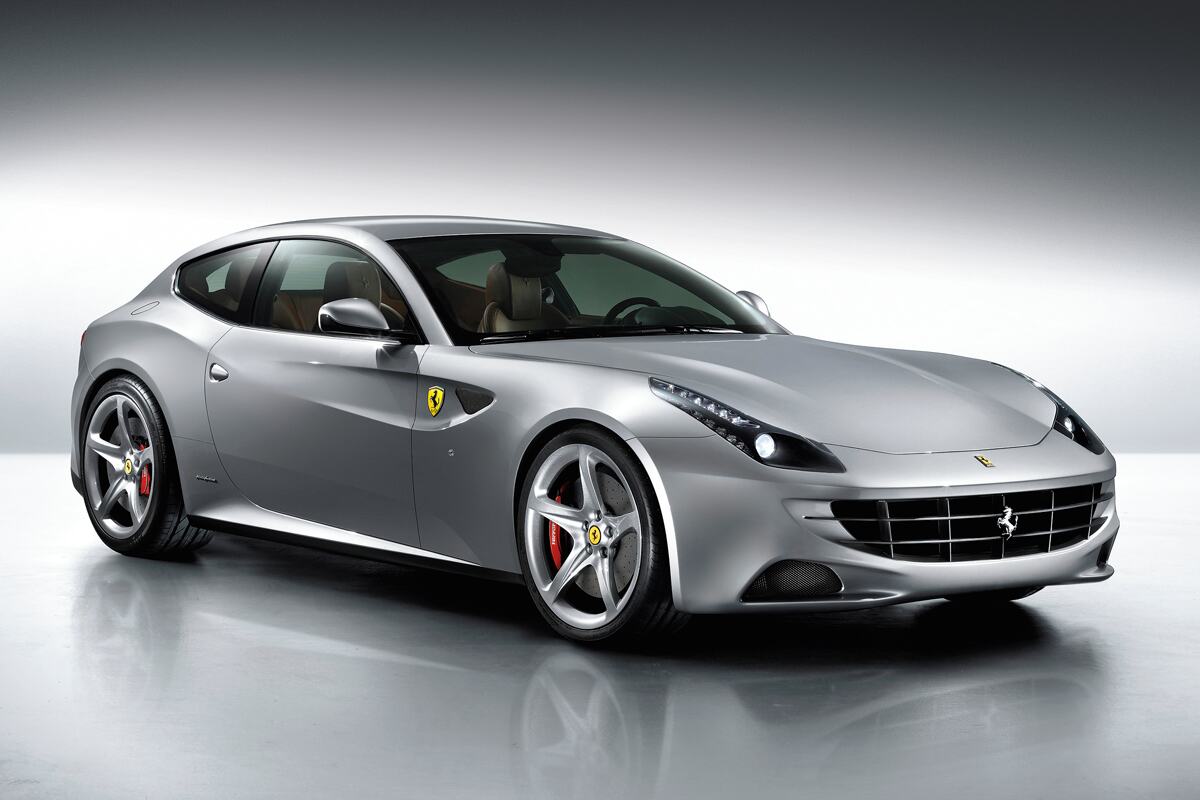
The FF offers serious speed, a spacious cockpit, and all-wheel drive—for less than half the price when new.
Photos by Ferrari
October 24, 2024
A few years after introducing the all-new California, Ferrari shook up its lineup once again at the 2011 Geneva Auto Show. There, the company unveiled the innovative Ferrari Four, officially known as the FF. Like the 612 Scaglietti it replaced, the FF featured four seats. Unlike the 612, or any other Prancing Horse, it also boasted all-wheel drive.
Created completely in-house with the assistance of former World Rally Champion Markku Alén, Ferrari’s 4RM (for Ruote Motrici, a.k.a. Wheel Drive) system consisted of a two-speed gearbox mounted to the front of the engine and driven by the crankshaft. Using a series of wet carbon-fiber clutches and some intensive computing power, the gearbox directed torque to the front wheels when the rear wheels (themselves driven by the car’s seven-speed dual-clutch F1 transaxle) lost grip.
Ferrari released a number of videos showing the FF sailing serenely through the snow, but most owners were more interested in what resided under |the hood: a 6.3-liter V12. Producing 660 horsepower (a full 120 ponies more than the 612) and 504 lb-ft of torque, those 12 cylinders could launch the two-ton-plus FF from rest to 62 mph in just
3.7 seconds. The Ferrari’s top speed was 208 mph.
Aiding that impressive terminal velocity was the FF’s smooth and striking shape. While a few companies had converted Ferrari coupes and berlinettas into station wagons before, the FF was the factory’s first, which it called a shooting brake. Whatever the name, the FF combined a recognizably Ferrari front end and numerous traditional design cues with an extra-long roof that provided enough headroom for full-size adults to fit comfortably in back (along with a trunk space twice as big as that of the 612, to boot).
While the FF’s exterior was styled by Pininfarina, as had been the tradition for more than five decades, its interior, like the 4RM, was an in-house effort. Ferrari Centro Stile, under the watchful eye of design director Flavio Manzoni, reworked, modernized, and harmonized the luxurious, leather-lined cockpit. Comfort was important for the car’s Gran Turismo mission, and the big Ferrari delivered with a smooth (if not exactly plush) ride and an extremely quiet cockpit (at least until the V12 spun up in anger). In 2014, the FF even became the first car in the world to feature Apple CarPlay.

In the time since its debut, the FF has proven to be everything the company intended: a fast, comfortable, reliable, spacious, all-weather touring machine. Better still, these fabulous GTs are now available
at less than half their original price. If the FF formula sounds appealing, there’s never been a better time to check one out.
Marketplace
Although the FF never commanded a six-figure over-sticker premium when new, like Ferrari’s newest sports cars often do, it was still an expensive proposition. The four-seater’s base price started at $295,000, and Maranello’s very profitable habit of piling on the options instantly took out-the-door prices into the $350,000-375,000 range—or more. While carbon-ceramic brakes and 20-inch wheels were standard, many buyers were tempted by pricey treats like a carbon-fiber steering wheel ($5,000), dash inserts ($7,500), and driver’s zone (also $7,500), a backup camera ($3,600), suspension-lifter system ($5,800), and AFS headlights ($2,000), along with the practically obligatory Scuderia fender shields ($1,600) and colored brake calipers ($1,400). Furthermore, many window stickers included a substantial four-figure sum for unspecified “Other Options.”
No factory production figures are available for the FF (or any other regular-production model of recent years). However, research suggests that 3,113 FFs were built in total between 2011 and ’16, and 782 of those came to the United States.
That generous supply (there are usually 100 or more available for sale worldwide at any given time), the power of depreciation, and the arrival of its latest-and-greatest successors (first the GTC4Lusso and now the Purosangue), have conspired to push FF prices down. Early, high-mileage examples sell for as little as $85,000, with late, low-mileage, heavily optioned cars often coming in under $130,000.
It’s difficult to describe a high-five or low-six-figure price tag as inexpensive, but the FF is a seriously good buy. There’s a reason these machines accumulate more miles than Ferrari’s sports cars; they are comfortable, reliable, versatile, spacious, and all-season friendly. At the same time, they offer more performance than most drivers can ever use. The most consistent knock against the FF is its once-controversial styling, but you’ll forget all about the exterior once you’re behind the wheel. —Michael Sheehan

| Model | Low | High |
|---|---|---|
| FF | $85,000 | $130,000 |
These prices are for nicely optioned, well documented,
and fully serviced cars in good to great condition as of October 2024.
On The Road
The FF brought more power, performance, and sophistication to Ferrari’s 2+2 lineup than ever before. Here’s some of what we’ve said about the model since its introduction.
“Fantastic Four,” FORZA #113
This Ferrari has an amazing ability to fly down bad roads. When the going gets rough, the FF seems to elevate above it all, distancing the driver from the clutter below while still maintaining an iron grip on the proceedings. As the road pitches and heaves its way downhill through a mid-forest meadow, my right foot stays flat on the floor.
From the driver’s seat, the experience is a mix of astonishment and adrenaline. The only other cars I’ve driven that offer this kind of serious, effortless speed over battered tarmac are the Audi R8 and the 458, and I’m not sure either of those low-slung machines could handle some of these craters as well as the FF. Big bumps seem to disappear under its wheels.
The car turns in sharply—far more quickly than its size would suggest—and tracks true. The FF can’t dance on a dime like the slalom-conquering Porsche Panamera Turbo, let alone an extreme sports car like the 458, but it feels very athletic and extremely amenable to hard driving.

When I get on the power, the FF rockets out of turns with the urgency of a 458. It might be even quicker, given the V12’s horsepower and torque advantage, the FF’s all-wheel-drive system (which is designed to kick in when the rear tires lose grip), and a traction-control setup that won’t let the rear wheels spin unless all the electronic driver’s aids
“The Long Game,” FORZA #125
I had spent my first day in the FF tearing around Los Angeles, mostly on a mix of poorly paved, traffic-clogged surface streets and freeways. If this sounds like a miserable place to drive a Ferrari, it is—but only in the sense that speeds are low. The FF handled this challenging environment with real nonchalance.
The dual-clutch transmission is one reason the Ferrari makes such a sublime city dweller. The automated clutch take-up is smooth, allowing the car to move off the line seamlessly. Throttle response is equally seamless, allowing me to drive around smoothly at part throttle without the lurchiness caused by the 458 Italia’s hyper-sensitive
right pedal.
The second reason for the FF’s city friendliness is its light and fast steering, which is paired with a very tight turning radius. The practical effect of these attributes, when combined with the FF’s instant response to inputs, is that it doesn’t take long to get comfortable with the close-quarters cut and thrust of urban driving.
There is one minor shortcoming in the FF’s accommodating nature, however: ride quality. Those expecting the plush ride of a big Lexus, Mercedes, or Bentley will be disappointed by the Ferrari’s relative tautness, as well as the way road imperfections are transmitted through its steering wheel and seat.

The Garage
The FF has proven as rugged and reliable as any low-production supercar can hope to be. The only issue most owners are likely to encounter are software updates, which are relatively frequent and require a trip to an official dealer.
The usual wear-and-tear items have proven to be impressively robust, and maintenance costs are minimal by exotic-car standards. Expect to pay $2,500 for an annual service (with much of that cost going toward lubricants), and the long dreaded, twice-a-decade cam-belt service is a thing of the past. I spoke with several dealers who had to replace secondary wiring harnesses, while one dealer in a very congested, hilly city has encountered a handful of clutch issues, but these were rare occurrences.
There’s a “but” here, unfortunately, and it’s the FF’s transmission(s). With time and miles, the seven-speed dual-clutch transaxle (which was also used, with minor variations, in the 458, 488, F12, and California) can develop internal oil leaks and/or solenoid and sensor failures. Since the transaxle needs to be removed and opened up to fix almost any issue, Ferrari’s solution is to simply replace it—at a cost of roughly $55,000. However, a qualified shop with the right specialized tools can rebuild it with all-new seals, sensors, and bearings for $20,000-30,000. The price will vary depending on what’s needed; if new wet clutches are required, expect to add another $13,000 to that range.
The all-wheel-drive FF has a second transmission: a two-speed Power Takeoff Unit mounted to the front of engine that drives the front wheels. If the PTU suffers an internal oil leak, gear oil can be sent into the engine or engine oil can make its way into the gearbox, causing a failure
of either the gearbox, the engine, or both.
Sourcing a replacement PTU from Ferrari is very expensive and, given that you’re replacing like for like, there’s a possibility the same issue will arise again in the future. The shops I surveyed recommended shipping a faulty PTU to England, where Parkes Performance will rebuild and upgrade the unit with its own billet parts for roughly $11,000 (plus crating and shipping).
With more and more FFs out of warranty—the newest examples are now seven years old—independent servicing is now a viable option. However, many owners stick with their dealer’s service department due to the popularity (or is that necessity?) of Ferrari’s extra-cost, long-term warranties and the FF’s astonishing electronic complexity.
Like all modern exotics, the FF utilizes a Controller Area Network (CAN) that links all its computers together, from powertrain and anti-lock brakes to stability control and keyless entry to dozens of others. If something goes wrong, these systems can cross-talk, throwing off difficult-to-track-down warning codes that can only be interpreted by a dealer or a private shop with the very latest $25,000 Leonardo computer.
As always, do your research, buy the best car you can afford, and have any potential purchase inspected by a shop that knows the model inside and out. —Michael Sheehan